How to Choose the Best LED Lighting Solutions?
Choosing the right led lighting solutions involves more than comparing brightness, wattage, or glossy product images. A suitable system must match the room’s purpose, ceiling height, operating hours, color preference, and maintenance conditions. A warm 2700K lamp may create comfort in a hotel lounge, while a neutral 4000K fixture can improve visibility in a workshop. Glare, shadowing, flicker, and poor beam control still matter.
Dr. Mariana Figueiro, a leading lighting researcher, has described light as “a powerful regulator of the human circadian system.” Her observation reminds buyers to consider people, not only energy bills. A school corridor, retail counter, warehouse aisle, and bedroom require different lighting decisions. The best led lighting solutions should provide reliable illumination, efficient energy use, suitable color rendering, and practical controls. Look for tested performance data, warranty terms, thermal management, and compatibility with dimmers or sensors. Details matter.
Experience also exposes uncomfortable limits. The brightest fixture is rarely the best fixture. A low-cost product may save money today, then fail early because of heat, weak drivers, or difficult replacement parts. That happens. Even professional specifications can overlook cleaning schedules or changing furniture layouts. A careful decision therefore combines manufacturer evidence, site measurements, installer knowledge, and real user feedback. This guide explores those factors clearly, while acknowledging that no single lighting package fits every building, budget, or visual task. Real rooms are less predictable than brochures suggest.
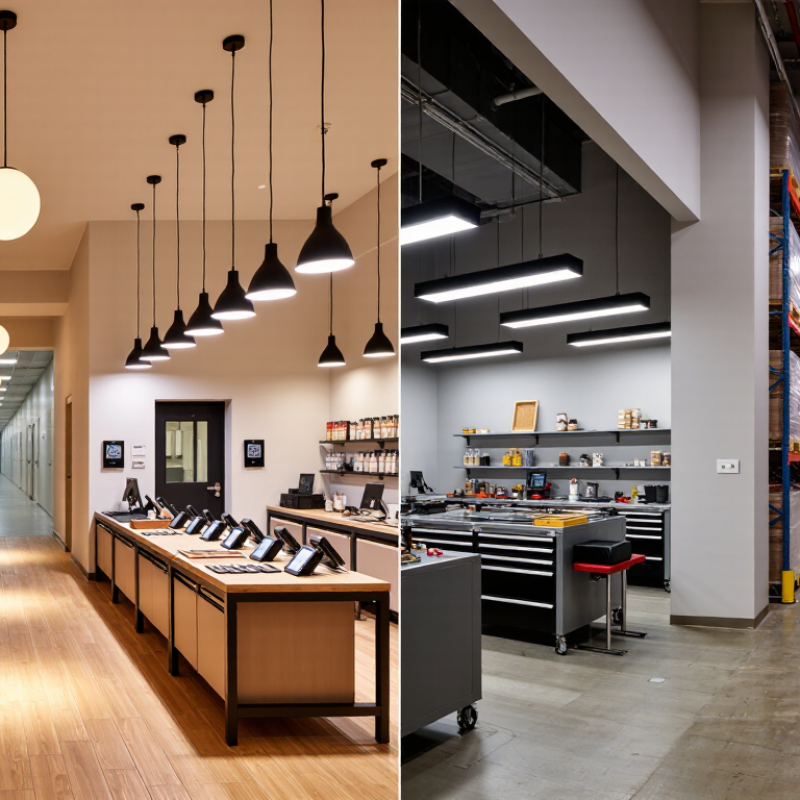
Define Lighting Goals with 100–200 lm/W Efficacy and 80+ CRI Benchmarks
Choosing LED lighting starts with the task, not the fixture.
Measure work surfaces, ceiling height, operating hours, and daylight before comparing products. A warehouse aisle may need efficiency, while a bakery display needs accurate color. Set a practical target of 100–200 lumens per watt for efficient systems. Treat this as a range, not a promise. Driver losses, optics, dimming, and temperature can reduce delivered performance.
For color quality, use 80+ CRI as a baseline in offices, corridors, and general retail. Higher CRI matters where skin tones, fabrics, food, or printed samples must look trustworthy. Check the R9 value when red objects need natural rendering. Ask for test reports showing lumen output, power input, CCT, CRI, and test conditions. Numbers without conditions can mislead.
A warm 3000 K source may feel comfortable, while 4000 K can support a crisper workspace. Choose based on occupants and tasks, not trends.
During one retrofit, I focused too heavily on wattage. The lower-energy option created glare near polished desks. We adjusted beam angles and added dimming, but the layout still exposed a planning mistake. Review spacing, uniformity, flicker, glare, controls, warranty, and maintenance access. Pilot a small area for several evenings. Observe shadows and eye comfort. Recheck actual power after installation. The plan may need revision.
Match CCT, Beam Angle, and UGR to Each Space’s Visual Tasks
How to Choose the Best LED Lighting Solutions?
Choosing LED lighting starts with the visual task, not the fixture’s appearance. Correlated color temperature, or CCT, should support the space’s purpose. Warm light around 2700–3000K can make lounges and restaurants feel comfortable. Neutral light around 3500–4000K often suits offices, classrooms, and retail counters. Detailed inspection may need cooler light, but higher CCT is not automatically better. Test samples under real finishes. White walls can shift the perceived color.
Beam angle controls where light lands. A narrow 15–30° beam can highlight artwork, shelves, or a product display. Wider 60–90° beams spread light across desks, aisles, and circulation zones. Match the angle with ceiling height and mounting distance. A narrow beam mounted too low creates bright spots and dark gaps. It looks dramatic. It may work poorly.
UGR addresses discomfort glare, especially around computer screens. Many office designs target UGR below 19, yet room layout still matters. Reflective desks, glossy floors, and exposed light sources can increase glare. Review photometric files, installation drawings, and applicable lighting standards before approval. A practical mock-up reveals problems calculations may miss. I once underestimated monitor reflections in a small office; the light level was acceptable, but the space felt tiring. Repositioning fittings helped more than increasing output. Leave room for adjustment.
Verify 50,000–100,000-Hour Life Using LM-80 and TM-21 Reports
How to Choose the Best LED Lighting Solutions?
A claimed 50,000–100,000-hour life needs evidence, not attractive packaging. Ask for LM-80 reports covering the actual LED package, drive current, and operating temperatures. LM-80 records lumen maintenance over time under controlled laboratory conditions. It does not directly prove a complete fixture will last that long.
TM-21 uses LM-80 measurements to project lumen maintenance beyond the test period. Check the reported projection period, calculation limits, sample size, and temperature conditions. A reliable supplier should provide complete reports, not only a printed lifetime number. Compare the tested conditions with your installation. A hot ceiling, poor ventilation, or frequent switching may reduce practical performance. I have seen projects fail because the report covered a cooler test condition than the real site. That detail is easy to miss.
Tips: Request LM-80 data for the exact LED model. Confirm TM-21 results match the selected current and temperature. Check whether the lifetime means L70, L80, or another maintenance level. L70 means the light output reaches 70% of its initial value. Also review the driver’s rated life, warranty terms, and thermal design. The LED may be excellent, yet the driver can fail earlier. One uncertainty remains: projected life is still a prediction, not a promise. Ask for field data when available.
How to Choose the Best LED Lighting Solutions?
Verify 50,000–100,000-hour life claims by reviewing LM-80 lumen-maintenance measurements and TM-21 projections. Higher operating temperatures generally produce faster lumen depreciation.
Representative lumen-maintenance profiles based on common LM-80 test reporting intervals and TM-21 projection practice. LM-80 measures LED package, array, or module performance under controlled conditions; TM-21 uses those results to project long-term lumen maintenance. Actual values must be verified from the specific product’s test report.