China Top 10 Double Sided LED Screen Manufacturers
A Double Sided Led Screen gives brands two directions of visibility from one carefully planned installation. It can serve commuters approaching a station entrance, shoppers moving through a mall corridor, or visitors crossing an exhibition hall. Yet bright images alone do not make a display effective. Viewing distance, ambient light, pixel pitch, heat management, and maintenance access all shape its real-world performance.
Industry reports offer useful context, though they do not measure this product category alone. MarketsandMarkets has forecast continued growth in the broader digital signage market, reflecting wider investment in public-facing displays. That trend supports interest in double-sided LED solutions, but it should not be treated as proof that every installation will deliver the same return. Site conditions matter. So does the supplier.
This guide introduces ten Chinese manufacturers for buyers comparing product range, engineering capability, customization, and after-sales support. The selection is intended as a starting point, not a universal ranking. Specifications and service quality can change, and published claims deserve independent checking. Ask for test results, warranty terms, installation references, and a clear maintenance plan. Small details matter. A slim cabinet may look elegant in a showroom, but cable access and heat dissipation become more important after months of daily operation. Choosing well takes more than a brochure.
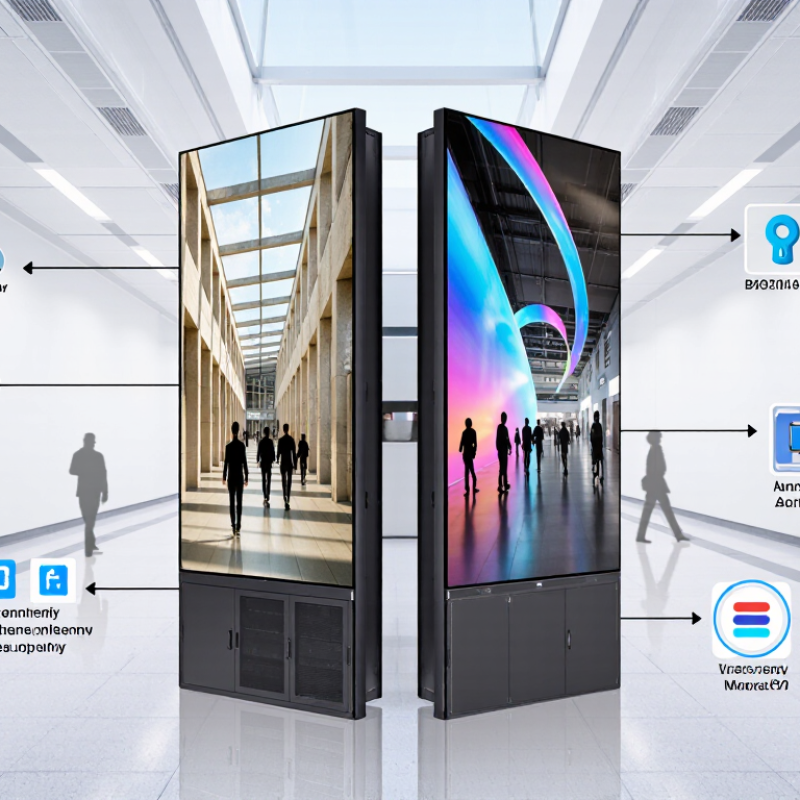
What Double-Sided LED Screens Are and How They Work
A double-sided LED screen displays content on two outward-facing surfaces, allowing people to view it from different directions. It is not simply two panels placed back to back. A typical system combines LED modules, control electronics, power supplies, and a supporting frame. The frame must hold both display faces securely while allowing enough space for ventilation and maintenance. Look closely at the cabinet edges. They often reveal how the structure manages weight and heat.
Each side can show the same image or different content, depending on the controller and installation design. For example, a screen suspended above a busy indoor walkway might show travel information on one face and advertisements on the other. The controller sends image data to each display, while receiving cards distribute signals across the LED modules. Brightness settings also matter. A sunny entrance may need stronger output than a dim corridor, but excessive brightness can waste energy and make viewing uncomfortable.
Installation conditions shape performance. Engineers consider viewing distance, ambient light, screen size, ventilation, and how technicians will reach the equipment. Heat is easy to underestimate. So is access. A double-sided unit can be heavier and more complex to service than a single-faced display, especially when mounted overhead. Exact requirements vary by project, and specifications alone cannot replace an on-site assessment. Even a well-designed screen may need adjustment after people begin using the space.
How China’s Double-Sided LED Screen Industry Is Organized
China’s double-sided LED screen industry is organized as a supply chain, not just a list of finished-screen factories. Component suppliers provide LED modules, cabinets, power systems, and control equipment. Manufacturers combine these parts into displays designed for locations such as shop windows, transport hubs, and exhibition spaces. Some companies focus on production, while others handle project design, installation, and maintenance.
The boundaries can blur. A factory may assemble screens and coordinate installation through local partners. Buyers should check who is responsible for each stage, especially cabinet design, heat management, wiring, and after-sales support. Double-sided units need careful structural planning because two display surfaces add weight and affect airflow. Ask for technical drawings, test records, and clear service terms. A polished demonstration is useful, but it cannot show every condition at an actual site. That distinction is easy to overlook.
Tips: Compare pixel pitch, brightness, viewing distance, and cabinet dimensions against the installation plan. Request a sample or operating video, and confirm which party handles repairs. One detail matters: access for maintenance. If technicians cannot reach the modules safely, a small fault can become a costly interruption. Industry descriptions sometimes make suppliers sound interchangeable; in practice, capabilities and coordination vary, so verify the people and processes behind the product.
Criteria for Comparing China’s Leading Manufacturers
When comparing China’s double-sided LED screen manufacturers, look beyond quoted price and pixel pitch. The MarketsandMarkets report LED Display Market, 2023, estimated the global market at USD 7.1 billion and forecast USD 12.7 billion by 2028. That growth makes production capacity relevant, but a large factory alone proves little. Ask for measured brightness on both faces, color uniformity, refresh rate, and power use under a defined test pattern. Request test records from the same cabinet configuration you plan to buy.
Reliability shows up in details. Check cabinet weight, heat paths, sealing, service access, and whether one side can be repaired without removing the other. Request operating-temperature and lifetime data, plus the test method behind each figure. IEC 62368-1 is a useful safety reference, though compliance claims should be verified for the actual product and destination market.
Omdia’s LED Video Display Market Tracker provides useful market context; it does not replace factory audits or sample testing. A polished demo can still hide uneven brightness after warm-up. Compare written warranties, spare-module availability, and response times, then confirm them in the purchase specification. Slightly awkward, but important: insist on seeing performance after extended operation, not just a fresh unit.
Profiles of 10 Notable Chinese Double-Sided LED Screen Manufacturers
China’s double-sided LED screen sector serves retail streets, transport hubs, exhibitions, and other spaces where viewers approach from either direction. This article profiles ten notable manufacturers, focusing on practical differences rather than promotional claims. Key comparison points include cabinet depth, pixel pitch, brightness control, service access, and installation options. Small details matter. A shallow cabinet can ease placement on a narrow sidewalk, while front-and-rear maintenance access may reduce downtime in a busy venue.
Grand View Research estimated the global LED display market at about US$7.1 billion in 2023, with an expected compound annual growth rate of 8.4% from 2024 to 2030. This broad market figure does not isolate double-sided screens, so it should not be treated as a segment forecast. It does, however, show why buyers need to examine product specifications closely. The ten profiles consider manufacturing experience, project customization, quality-control practices, and available technical support. Buyers should verify viewing distance, weather protection, and power use against their own site conditions. Published specifications can omit installation constraints. That is a limitation worth remembering.
Applications, Customization, and Buyer Considerations
Double-sided LED screens serve places where viewers approach from both directions, such as station halls, retail windows, exhibition entrances, and street-facing kiosks. A display mounted above a walkway can share schedules on one side and promotional content on the other. The right application depends on viewing distance, ambient light, and how long people can comfortably watch. A bright screen behind glass may look vivid at noon, yet cause glare after sunset.
Customization begins with the installation, not the cabinet. Buyers should confirm the available width, height, mounting points, ventilation, and access for maintenance. Then they can specify pixel pitch, brightness, refresh rate, and independent or synchronized content. For a narrow shop window, slim cabinets may preserve interior space; for a transit area, service access and stable playback may matter more than an ultra-thin profile. Small details count. Ask how cables are routed and how each side is controlled.
Compare manufacturers using measurable evidence: sample images, test reports, warranty terms, spare-part availability, and references from similar installations. Request a full-size mock-up or viewing test when possible. It reveals issues that a specification sheet can hide, including reflections, color differences between sides, or awkward service access. I would not choose on pixel pitch alone. It is tempting, but the cheapest quote may omit installation details, and even a carefully planned screen can disappoint if the content is hard to read.
Double-Sided LED Display Pixel Density by Pixel Pitch
Pixel density is calculated from pixel pitch using 1,000,000 ÷ pitch². These theoretical values help buyers compare resolution options when specifying displays for different viewing distances and applications; they are not manufacturer or market-share data.